

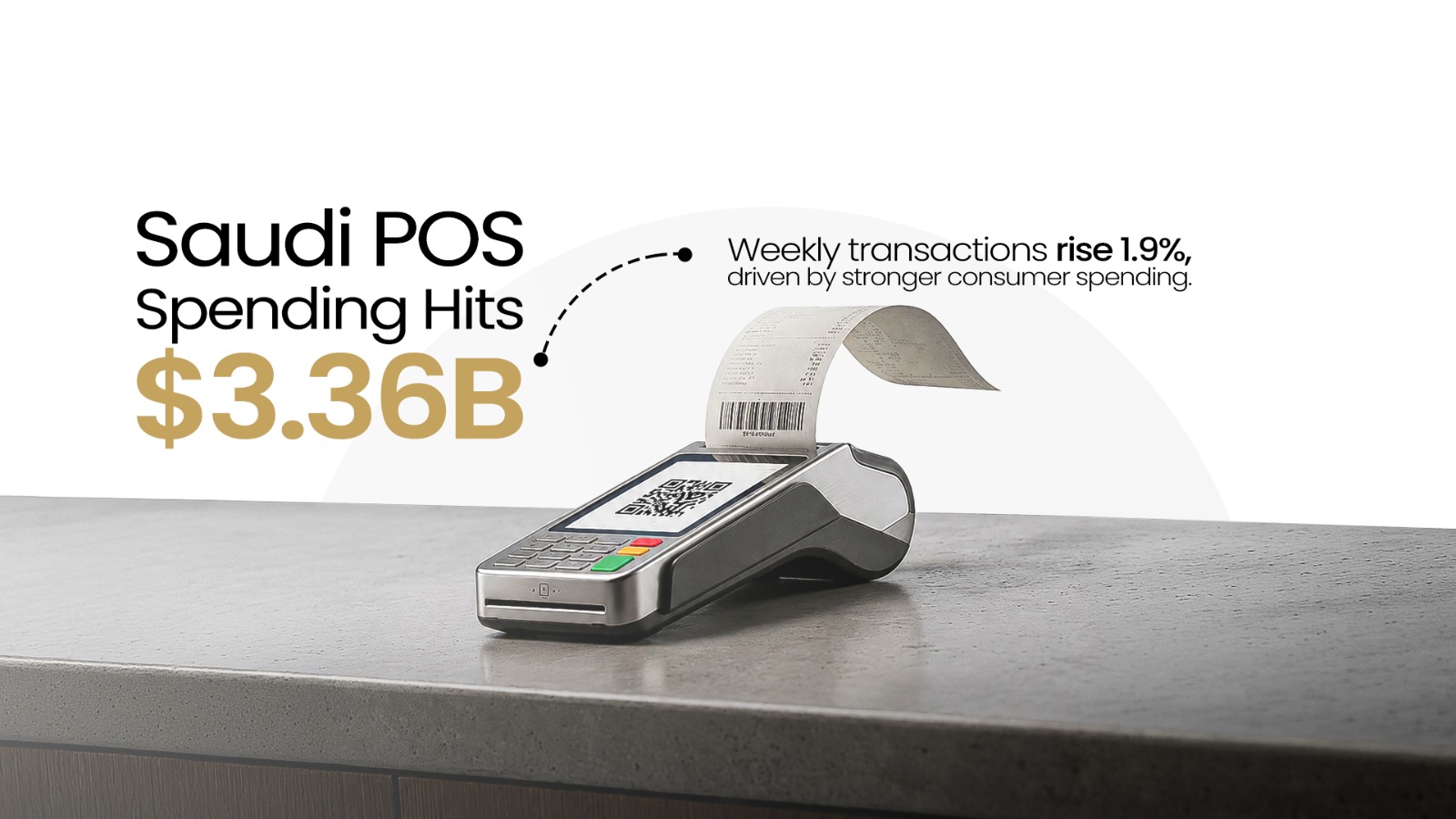
Saudi Arabia’s point-of-sale spending has once again highlighted the strength of consumer activity in the Kingdom. According to recent market reports based on Saudi Central Bank data, weekly Saudi POS spending edged up by 1.9% to $3.36 billion, reflecting continued movement across retail, food, services, lifestyle, and other consumer-driven sectors.
For businesses, this is more than a weekly Saudi PS spending update. It is a signal of a wider economic story: Saudi consumers are active, businesses are transacting, and the Kingdom’s domestic economy continues to show resilience.
Consumer Spending Is Becoming a Key Indicator of Saudi Growth
Point-of-sale transactions are one of the most practical indicators of day-to-day economic activity. They show how consumers are spending across physical stores, restaurants, supermarkets, pharmacies, service outlets, and other merchant categories.
The Saudi Central Bank publishes weekly POS transaction reports covering the number and value of transactions across business activities and cities in Saudi Arabia. These reports are used to track electronic payment activity through POS terminals across the Kingdom.
When POS spending rises, it usually reflects stronger consumer participation in the economy. It also shows that businesses are receiving more payments through formal, traceable, and digital channels. This is important for Saudi Arabia’s broader shift toward a more transparent and digitised economy.
A Sign of Stronger Domestic Demand
The rise in weekly Saudi POS spending shows that domestic demand remains active. In simple terms, people are spending, businesses are selling, and money is moving through the economy.
This matters because consumer spending supports many sectors at the same time. Retailers benefit from higher sales. Restaurants and cafés see better footfall. Service businesses receive more transactions. Banks and fintech companies process more digital payments. Even accounting, tax, compliance, and advisory firms see a stronger need for structured reporting as businesses grow.
For Saudi Arabia, this is especially relevant because the economy is moving through a major transformation under Saudi Vision 2030. Growth is no longer viewed only through oil revenue. The expansion of non-oil activity, private sector participation, digital payments, tourism, entertainment, retail, logistics, and SMEs is now central to the Kingdom’s economic direction.
Saudi Arabia’s Ministry of Finance has also highlighted that non-oil activities continue to lead economic growth, supported by reforms that enhance private sector contribution to GDP and maintain inflation below global levels.
Digital Payments Are Changing the Business Landscape
The growth in Saudi POS spending is also a reflection of a fast-moving digital payment culture. More consumers are using cards, wallets, and electronic payment channels for everyday transactions. This creates a more measurable economy and gives businesses better visibility over sales patterns, cash flow, and customer behaviour.
For companies operating in Saudi Arabia, this shift brings both opportunity and responsibility.
The opportunity is clear: higher digital transactions can support better revenue tracking, improved customer insights, stronger financial forecasting, and easier expansion planning.
The responsibility is equally important: businesses need proper accounting systems, tax-ready records, payment reconciliations, internal controls, and compliance documentation. As transaction volumes grow, informal tracking becomes risky. Businesses need systems that can support scale.
What This Means for Saudi Businesses
The increase in Saudi POS spending should encourage business owners to look beyond the headline number.
The real question is not only “How much are consumers spending?”
The better question is: Is your business ready to capture, manage, and report this growth properly?
Businesses in retail, F&B, healthcare, services, trading, hospitality, and e-commerce should use this period to strengthen their financial and operational foundations.
A growing market requires
- Better cash flow monitoring
- Accurate revenue recognition
- POS-to-bank reconciliation
- VAT and ZATCA compliance readiness
- Inventory and margin analysis
- Customer spending pattern reviews
- Digital payment controls
- Regular management reporting
As consumer spending grows, business decisions cannot depend only on bank balances or monthly sales totals. Owners need real-time financial visibility and structured financial advisory support.
The Bigger Message: Confidence Is Building
A 1.9% weekly increase in Saudi POS spending looks small at first glance, but in a market the size of Saudi Arabia, consistent movement in POS spending is meaningful. It shows that economic activity is not standing still. It indicates that consumers are participating, businesses are moving, and the payment ecosystem is becoming more digital and transparent.
Recent SAMA-linked reports have repeatedly shown POS values staying in the multi-billion-dollar weekly range, including weeks where transactions remained above the $3.5 billion level. (Arab News) This pattern points to a market with strong transaction depth and broad consumer participation.
For investors, this supports confidence in Saudi Arabia’s consumer economy.
For entrepreneurs, it shows that demand exists.
For established companies, it is a reminder to modernise systems and decision-making.
For finance teams, it reinforces the need for accurate, timely, and compliant reporting.
How Tass & Hamjit Supports Businesses in This Environment
We see Saudi POS spending growth as more than a spending statistic. It is a business signal.
When consumer activity increases, companies need stronger financial discipline. They need to understand whether higher sales are improving profitability, whether margins are protected, whether cash flow is healthy, and whether compliance requirements are being met. Our team supports businesses in Saudi Arabia.
Saudi Arabia’s consumer economy is moving with confidence. The businesses that benefit most will be those that convert transaction growth into structured financial insight.
Final Thought
Saudi POS spending reaching $3.36 billion is not just a number on a weekly report. It reflects a stronger consumer economy, a more active private sector, and a Kingdom that continues to move toward digital and diversified growth.
For Saudi businesses, the message is clear:
Consumer activity is rising. The economy is moving. The opportunity is real.
Now is the time to make smarter business decisions.
About The Author